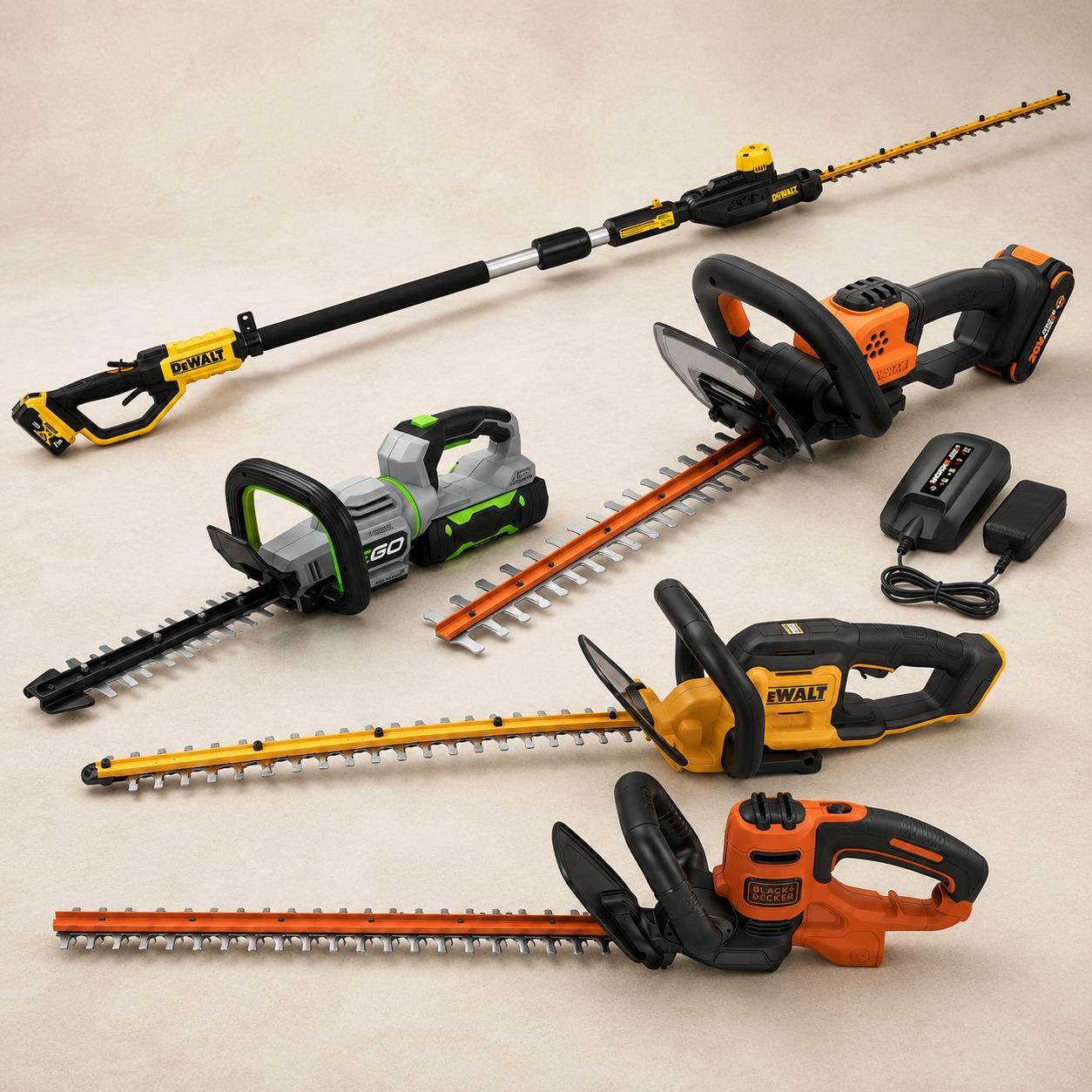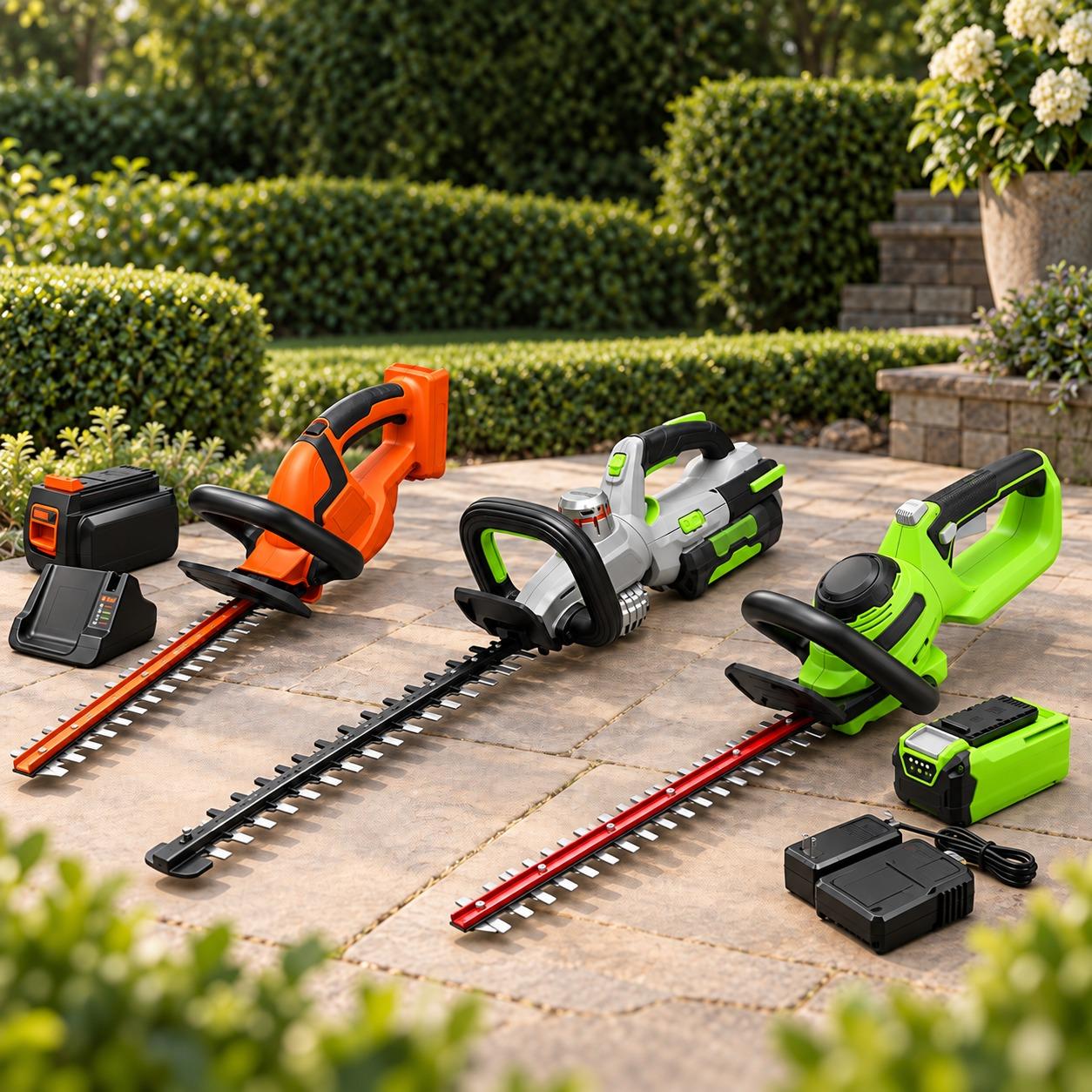
A hedge trimmer that feels manageable on small, shaped shrubs can become tiring halfway along a tall boundary. A light, short-blade model may be comfortable but require more passes on wide faces. The best cordless hedge trimmers match hedge condition and routine stem thickness to reach, cutting capacity, and a loaded weight you can control, not voltage alone. Readers choosing between battery and cable should use our corded vs cordless hedge trimmer comparison. If pole or gas power is still under consideration, compare all hedge-trimmer types.
Start with reach and branch thickness, then compare loaded weight, handle positions, and the battery package. A long blade covers more area but creates extra leverage. A large capacity rating offers margin, not proof of repeated cuts through equally thick hard or dead wood. Existing battery ownership also changes the economics; first-time buyers need to compare complete kit prices.
This guide ranks five cordless kits for different homeowner priorities and keeps the evidence limits visible.
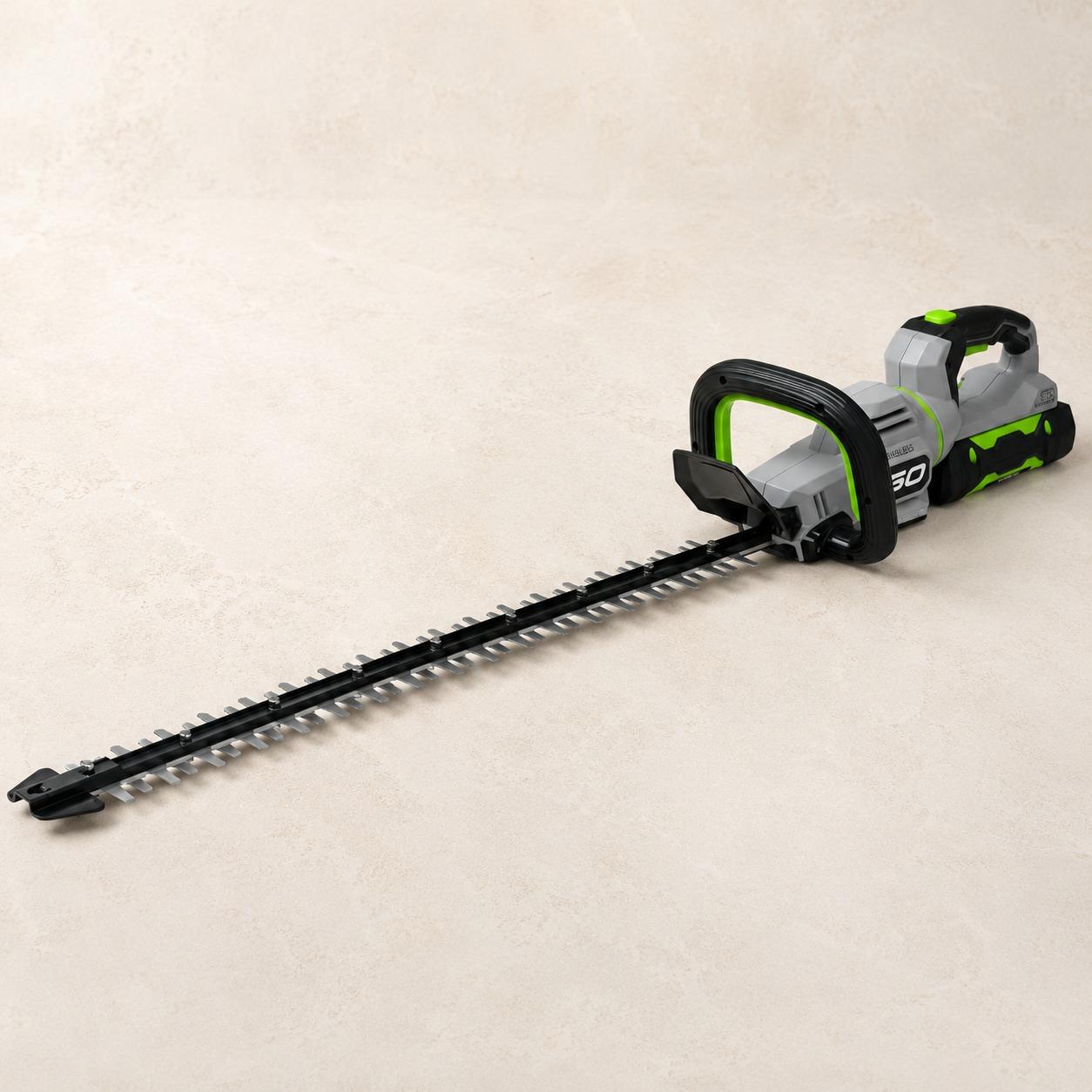
EGO POWER+ HT2601
“The HT2601 best suits homeowners with medium to large hedges who want long reach, a rotating handle, and a complete 2.5Ah kit. Its 26-inch blade is less nimble around tight shrubs, and its loaded weight is approximately 9.7 pounds (editorial estimate).”
Check Price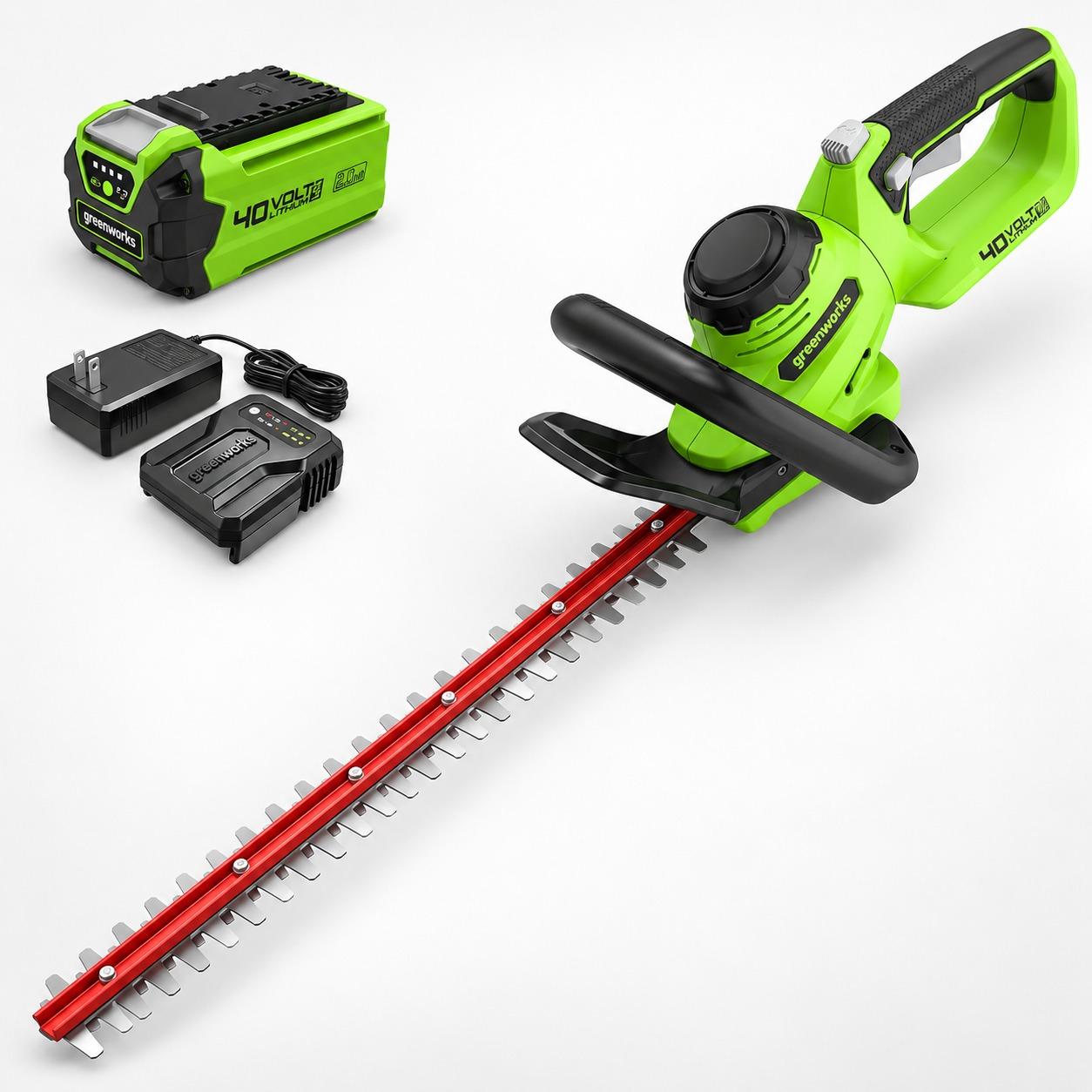
Greenworks HT40B212
“Greenworks combines a 24-inch blade, rotating rear handle, 2Ah battery, and 1-inch manufacturer-stated capacity in a well-rounded kit. It is a value-focused alternative for general residential work, but Greenworks has not published or verified the exact kit weight.”
Check Price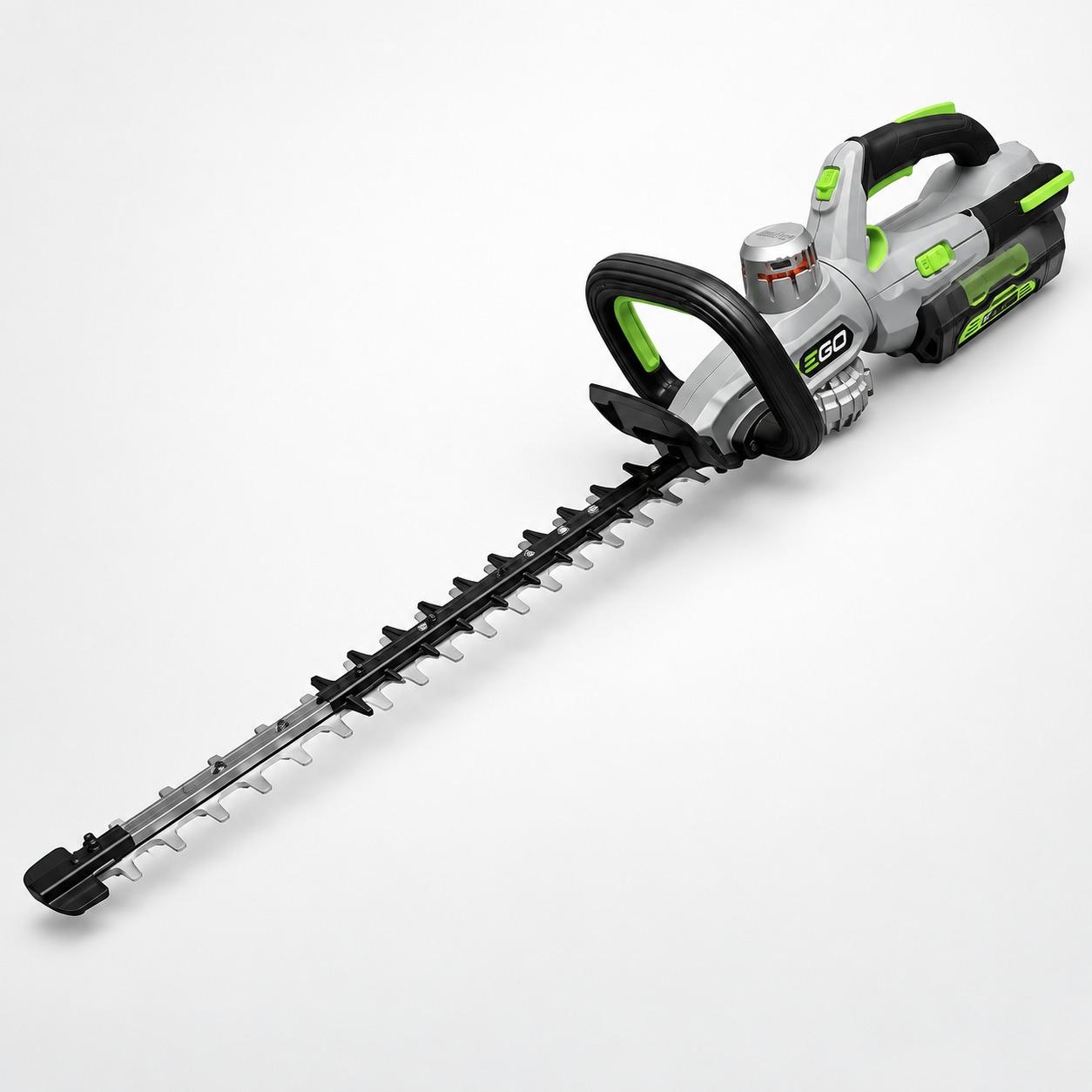
EGO POWER+ HT2501
“Choose the HT2501 when thicker maintained growth and two-speed control matter more than minimum fatigue. EGO states a 1.25-inch blade gap, the largest in this shortlist, but the estimated 11.2-pound loaded weight makes it the heaviest approved option.”
Check PriceCordless hedge trimmer comparison#
| Product | Best for | Blade / Capacity | Weight / Battery | Runtime claim | Control / Limitation | Check |
|---|---|---|---|---|---|---|
| EGO POWER+ HT2601 | Best Overall, medium-to-large hedges | 26 in / 1.2 in | 9.7 lb / 2.5Ah | Up to 60 min* | 180° rotating handle; long blade is less nimble | Check Price |
| Greenworks HT40B212 | Best Value, general homeowner use | 24 in / 1 in | Unverified / 2Ah | Up to 60 min* | 180° rotating handle; loaded weight unverified | Check Price |
| EGO POWER+ HT2501 | Best for Thick Hedges | 25 in / 1.25 in | 11.2 lb / 2.5Ah | Up to 40 min* | Rotating handle + 2 speeds; heaviest here | Check Price |
| WORX WG261 | Best Lightweight Option, small-to-medium yards | 22 in / 3/4 in | 5.5 lb / 2Ah | Conflicting brand answers | D-grip/front switch; modest battery package | Check Price |
| BLACK+DECKER LHT2436 | Existing 40V platform owners | 24 in / 3/4 in | 9.5 lb / 1.5Ah | Expected 50 min* | Wraparound handle; heavy for its capacity | Check Price |
Product reviews#
EGO POWER+ HT2601
For medium-to-large residential hedges, the HT2601 offers the best balance of reach and handling in this group. Its 26-inch blade and five-position handle support broad, angled cuts, while the 2.5Ah kit avoids a separate battery purchase. Loaded weight is approximately 9.7 pounds based on official published component figures.
Greenworks HT40B212
The HT40B212 is the middle-ground choice for routine trimming: a 24-inch blade is easier to place than either EGO blade, while the rotating handle still supports top and side cuts. Its kit includes a 2Ah battery and charger, and Greenworks covers both for 3 years. Exact loaded weight remains unverified.
EGO POWER+ HT2501
Buyers who regularly meet thicker green growth get more control from the HT2501's two speed settings and rotating handle. EGO lists a 1.25-inch blade gap, the largest here, but that specification is an upper limit rather than a performance test. With its 2.5Ah battery, estimated loaded weight reaches 11.2 pounds.
WORX WG261
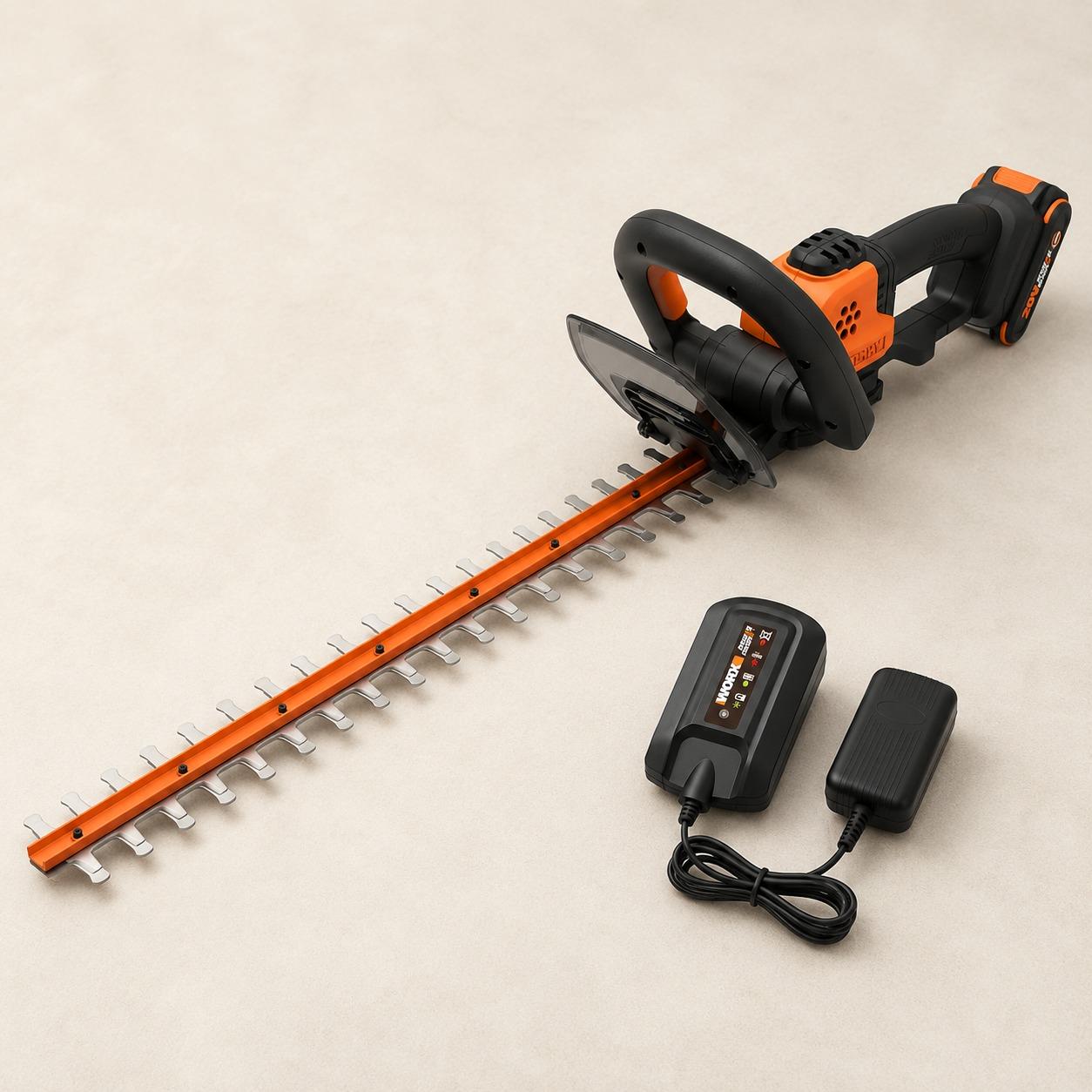
At an official 5.5 pounds with the battery installed, the WORX WG261 is the clear choice for buyers prioritizing low fatigue. Its 22-inch blade, D-grip, all-around front switch, 2Ah battery, and included charger suit regularly maintained small-to-medium yards. WORX states a 3/4-inch capacity, but its published runtime answers conflict.
BLACK+DECKER LHT2436
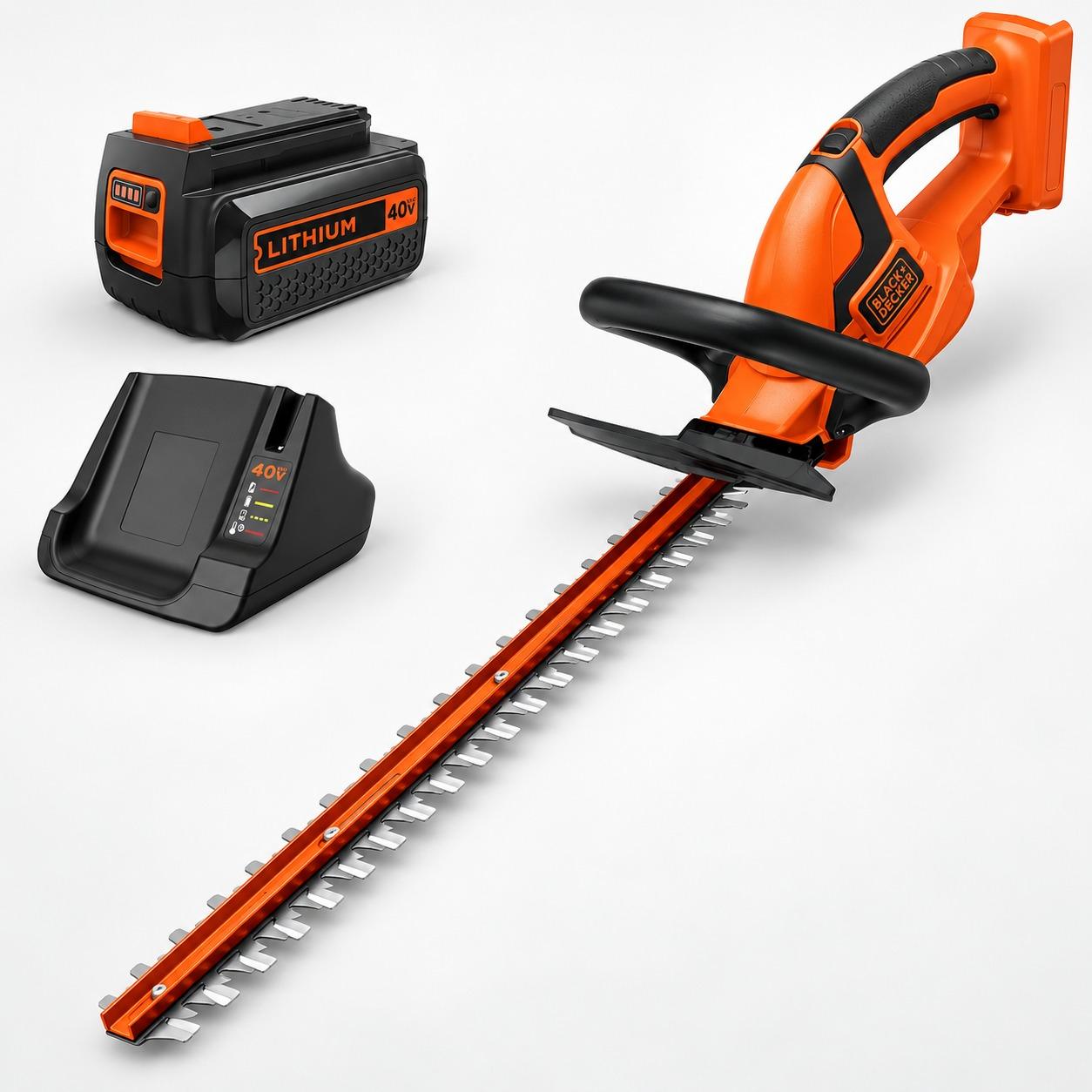
Existing BLACK+DECKER 40V owners have the clearest reason to consider the LHT2436. The kit pairs a 24-inch blade with a 1.5Ah battery, charger, wraparound grip, full-length trigger, and charge indicator. At 9.5 pounds with a 3/4-inch stated capacity, however, it offers less capacity-to-weight margin than the newer picks.
How we evaluated the best cordless hedge trimmers#
This ranking is based on documented product fit rather than hands-on cutting tests. We used exact model manufacturer pages, manuals, the CPSC recall database, and verified kit identities. Limited customer feedback helped identify concerns about weight, controls, batteries, jamming, balance, and maintenance; it was not treated as technical proof or used to calculate failure rates.
Cutting fit and control carried 25%, followed by handling and fatigue at 20%. Battery package and safety/maintenance each carried 15% value, and evidence confidence each carried 10%, availability carried 5%. Capacity and runtime statements counted as documented brand claims, not independent results. Voltage alone earned no power advantage.
Value considered the complete kit, including battery and charger, platform usefulness, features, and support. It did not assume that a temporary price would remain available. Evidence confidence also affected the results, a useful feature with unclear exact model documentation could not receive the same credit as a clearly documented specification.
Types of cordless hedge trimmers#
The clearest product types come from physical design and intended job, not battery voltage. Categories can overlap, but each one below solves a different problem.
Standard handheld hedge trimmers
Standard handheld models place front and rear grips close to a full-length blade, giving you direct control over sides, faces, and reachable tops. They fit routine maintenance from stable ground and handle both shaping and sweeping passes. Their limitation is physical load: holding any full-size blade away from your body becomes tiring during a long session.
Lightweight and compact hedge trimmers
Lightweight and compact trimmers put less load on your hands and create less blade leverage. They suit small-to-medium yards, detailed shaping, short sessions, and regularly maintained green growth. In exchange, a shorter blade needs more passes on a long boundary, while a small battery or capacity rating may leave less margin for dense sections.
Long-blade hedge trimmers
Long-blade models cover more of a broad face in one pass and reach farther across hedge tops. They make sense for straight boundaries and mature hedges where coverage matters. Extra length shifts weight away from your hands, though, making tight spaces and detailed corners harder. The benefit only pays off if you can control the loaded tool.
Heavy-duty hedge trimmers for thick growth
Heavy-duty handheld models add capacity margin, stronger drive components, longer blades, or multiple speeds for dense maintained growth. They suit established hedges with substantial green stems, not occasional deadwood renovation. The tradeoff is usually more weight and cost. Buyers with fine, frequently trimmed shrubs may gain little from the additional capacity.
Cordless pole hedge trimmers
A pole hedge trimmer places an often-articulating head at the end of a shaft, helping you reach tall faces and hedge tops from the ground. It solves a height problem rather than a general trimming problem. The distant head creates leverage, reduces fine control, and can fatigue shoulders quickly, so pole models are not direct substitutes for handheld tools.
Mini shrub shears and detail trimmers
Mini shrub shears use short blades for ornamental plants, boxwood shapes, edging, and touch-ups. Their compact head provides precision where a 22- to 26-inch blade would be clumsy. Limited reach and slow coverage make them poor choices for full hedge faces; they complement a standard trimmer rather than replace one.
Cordless hedge trimmer buying guide#
Choosing the right cordless hedge trimmer starts with your hedge size, branch thickness, and typical trimming time. Focus on cutting capacity, blade length, weight, and battery performance rather than voltage alone. The best choice should provide enough cutting power without becoming difficult or tiring to handle.
Hedge Size
Match the trimmer to the size, height, and density of your hedges. Small shrubs favor lighter, easier-to-control models, while long or tall hedges benefit from greater reach and longer runtime. Also consider how much trimming you normally complete in one session.
Blade Length
Longer blades cover wider hedge surfaces with fewer passes, while shorter blades provide better control around small shrubs and detailed shapes. A medium-length blade is usually the most versatile choice for typical residential hedges. Choose based on hedge size and maneuverability rather than assuming a longer blade is always better.
Cutting Capacity
Cutting capacity indicates the maximum branch thickness the trimmer is designed to handle. Choose a model with enough capacity for the stems you regularly cut, leaving some margin below its maximum rating. Thick, old, or woody branches are better handled with loppers or a pruning saw.
Weight & Balance
A hedge trimmer should feel comfortable when held at different angles and heights. Check its weight with the battery installed, as heavier tools can become tiring during long or overhead trimming. Good balance and ergonomic handles can improve control and reduce strain.
Battery Runtime
Choose enough battery capacity to complete your normal trimming session without frequent charging. Actual runtime varies with battery size, hedge density, branch thickness, and cutting intensity. Large yards may benefit from a higher-capacity or spare battery.
Battery Platform
Check whether the battery works with other cordless tools from the same brand or product line. Staying within a battery platform you already own can reduce the cost of buying additional tools and batteries. New buyers should compare battery, charger, and replacement costs before choosing a system.
Safety Features
Look for practical safety features such as two-handed controls, blade guards, and secure handles. Anti-jam functions can also help when dense growth stops the blades, but they should not be used to force the trimmer through oversized branches. Easy blade cleaning and lubrication are also important for maintaining reliable cutting performance.
Frequently asked questions
Are cordless hedge trimmers powerful enough for thick branches?
Yes, suitable cordless models can trim substantial green growth when their stated capacity leaves enough margin. Use a lopper or saw for old woody branches that approach the maximum or repeatedly stall the blade.
Is tooth gap the same as cutting capacity?
No. Tooth gap describes blade spacing, while a manufacturer may state a maximum stem diameter separately. Neither number guarantees the same result across green, hard, dry, or damaged wood.
How long does a cordless hedge trimmer battery last?
Runtime varies with battery capacity, hedge density, stem thickness, temperature, and technique. For a large yard, compare the included battery, charger speed, and cost of a compatible spare instead of relying on one brand minute figure.
Is a 20V hedge trimmer enough, or do I need 40V or 56V?
A 20V model can be enough for regularly maintained small-to-medium hedges. Choose by blade length, stated capacity, loaded weight, controls, battery package, and platform compatibility—not voltage alone.
Why do hedge-trimmer blades jam or click without moving?
Blades can stop because of debris, sap, bent teeth, an obstruction, a depleted battery, or a drive problem. Follow the manual's shutdown instructions and remove the battery when directed. Repeated clicking may require service, not more force.
Should I buy a tool-only hedge trimmer or a battery-and-charger kit?
Buy tool-only when you already own a compatible battery and charger in good condition. Otherwise, compare complete kits. Even platform owners should check whether a kit costs less than the bare tool plus an equivalent spare battery.
How often do hedge-trimmer blades need cleaning, lubrication or sharpening?
Follow the model's manual because cleaning and lubrication requirements differ. Sharpening depends on blade condition and use, not a universal calendar; some manufacturers recommend qualified service instead of owner sharpening.
When should I use pruning shears, a lopper or a saw instead?
Switch tools for isolated woody stems, renovation cuts, deadwood, or branches near the trimmer's maximum. Pruners offer precision, loppers add leverage, and a pruning saw handles larger wood.
Final recommendation#
The EGO POWER+ HT2601 offers the broadest homeowner fit: a 26-inch blade and rotating handle for large hedge faces, plus a complete 2.5Ah kit and 5-year tool warranty. Greenworks' HT40B212 trades some reach for a more maneuverable 24-inch format. The heavier EGO HT2501 suits thicker, maintained growth, while the 5.5-pound WORX WG261 favors low fatigue. Leave margin below any stated capacity and switch to a pruner, lopper, or saw for old woody branches.